Actor-Agnostic Governance: The Design Principle That Changes Everything
The default approach to AI agent governance is wrong. Not wrong in detail — wrong in premise. Most organizations are building separate governance infrastructure for AI agents when they should be building a single governance layer that applies to every actor in the workspace, human or machine.
This is the actor-agnostic governance principle, and it's the architectural decision that determines whether your governance scales or collapses when you move from a handful of agents to hundreds.
Why does governing "the AI" as a separate category break down?
The conventional model treats AI systems as a special category requiring purpose-built guardrails. Humans operate under existing policies, processes, and access controls. AI agents get a separate governance layer — AI-specific safety measures, AI-specific monitoring, AI-specific compliance artifacts.
This made sense when AI was a bounded component: a model running inference behind an API, invoked by a human, producing outputs for a human to review. Governing "the AI" was tractable because the AI had a clear surface area.
That model is obsolete. In an agentic architecture, AI systems plan, execute multi-step workflows, call tools, access databases, invoke other agents, and take actions with real-world consequences — often without human review of individual decisions. The Databricks 2026 State of AI report found that roughly 37% of enterprise deployments now use a supervisor pattern — one in which an orchestrating agent breaks work into subtasks, routes them to specialized agents, and assembles the final output. Microsoft's Agent Governance Toolkit, open-sourced in April 2026, exists precisely because the company concluded that agent-framework-level safety measures alone aren't sufficient for production governance.
When you build parallel governance — one set of controls for humans, another for agents — you get two identity systems, two audit trails, two policy enforcement mechanisms. Then you discover the hard part: in production, humans and agents operate in the same environment, access the same systems, and produce outputs that flow into the same downstream processes. The parallel approach fragments compliance evidence, creating gaps at every seam between the two systems.
What is actor-agnostic governance?
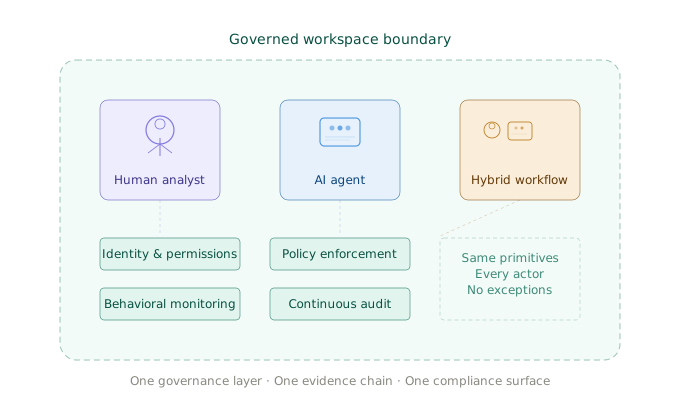
Actor-agnostic governance starts from a different premise: the governance boundary should be defined around the workspace, not around the type of actor operating within it.
A governed workspace has properties that apply regardless of who or what is doing the work:
Identity and credential scoping. Every actor — human, AI agent, hybrid workflow — operates under a defined identity with explicit, bounded permissions scoped to the task, not inherited from a broad role. This isn't novel for human access management. It's standard least-privilege architecture. The insight is that agents need the same primitives, implemented through the same governance surface. NIST's NCCoE concept paper on AI Agent Identity and Authorization, published in February 2026, explicitly explores how existing identity standards — such as OAuth, SAML, and federated identity frameworks — apply to agents that operate continuously and access multiple systems in sequence.
Policy enforcement at the boundary. The workspace enforces policy at the point of action—not after the fact, nor through actor-specific guardrails. When a policy says "no access to PII without authorization," that constraint applies at the boundary regardless of whether the accessor is a human analyst, an AI agent, or a multi-agent workflow.
Behavioral baselines with anomaly detection. Every actor's behavior is observed against expected patterns. A human analyst who suddenly exports 10,000 records triggers the same governance response as an agent attempting the same action. The monitoring infrastructure doesn't care about the actor type. It cares about the action, the context, and the deviation from expected behavior.
Continuous audit with full provenance. Every action, decision, and policy evaluation is logged — regardless of actor type. One audit infrastructure. One evidence chain. One compliance surface.
Actor-agnostic governance doesn't mean ignoring the differences between humans and AI agents — they have different risk profiles, failure modes, and monitoring requirements. It means the governance architecture doesn't branch based on actor type. The same primitives apply universally, with actor-specific parameters configured within the shared framework.
Why is this an architecture decision, not a policy decision?
The distinction determines what you build.
If you treat AI governance as a policy problem, you produce documents — frameworks, principles, review checklists, risk taxonomies. Those documents describe how governance should work. They don't enforce anything. As the ERIGO-AI™ framework states: "The problem is structural. Adding more policies, documentation, or oversight layers doesn't solve it. AI governance fails when it is treated as a policy problem instead of a system design problem."
If you treat it as an architecture problem, you build infrastructure — runtime enforcement, identity management, policy engines, audit pipelines. That infrastructure operates continuously, applies to every actor in the workspace, and produces evidence as a byproduct of normal operation.
NIST is moving in this direction. The AI Agent Standards Initiative, launched in February 2026, focuses explicitly on identity, authorization, and security for autonomous systems. The OWASP Top 10 for Agentic Applications, published December 2025, catalogs risks that are fundamentally about what agents do at the boundary — how they use tools, how they authenticate, how failures propagate across agent chains. These are governance-at-the-boundary problems, not AI-specific safety problems. AWS's AIRI framework takes a similar approach — it doesn't hardcode rules for known threats but instead continuously evaluates governance evidence against the applicable compliance standard, whether that's OWASP, NIST, or an internal policy.
The industry is converging on what security architecture has known for decades: access control, behavioral monitoring, and audit are properties of the environment, not properties of the actor.
What does this mean for organizations deploying AI agents?
Three implications follow from the actor-agnostic principle.
Consolidate your governance surface. If you have a separate governance infrastructure for humans and AI agents, you're carrying double the compliance burden with gaps at every seam. The Databricks report found that companies using structured governance tools deploy 12 times more AI projects into production than those that don't. The goal is a single governance layer through which all actors operate — one identity system, one policy engine, one audit trail, with actor-specific configurations within the unified framework.
Design for runtime enforcement, not just pre-deployment review. Pre-deployment testing is necessary but insufficient. The CSA's Agentic AI profile for NIST AI RMF calls for multidimensional behavioral telemetry in production—continuous observation of functionality, operations, security, and compliance. McKinsey's April 2026 research on scaling agentic AI makes the same point: governance needs to be embedded in the platform from the start, operating automatically as a default property of the environment rather than layered on after deployment.
Think in governance primitives, not AI guardrails. The primitives are identity, policy, observation, and evidence. They apply to every actor in the workspace. When you design from primitives rather than actor-specific guardrails, your governance architecture survives the next shift — from single agents to multi-agent orchestration to whatever comes after — because the primitives don't change. Only the parameters do.
How do you implement actor-agnostic governance?
The organizations that will govern agentic AI effectively are not the ones investing in the most sophisticated AI-specific safety measures. They're the ones building governance into the architectural boundary where all work happens — regardless of who or what performs it.
This is the design principle behind ERIGO-OS™. We didn't build an "AI governance tool." We built a runtime governance engine that enforces policy, manages identity, monitors behavior, and generates audit evidence at the workspace level. The same architectural primitives govern every actor. The same evidence chain supports every compliance requirement. The same enforcement mechanism applies whether the actor is a human analyst, a single AI agent, or a multi-agent workflow.
ERIGO-AI™ provides the governance framework layer — translating intent into governance controls through AI Architecture Decision Records, a maturity assessment across six pillars, and a signed governance profile that directly seeds ERIGO-OS runtime configuration. The stack governs itself: ERIGO-AI's engineering framework governs the architecture of ERIGO-OS, which was built using ARKAVUS-Dev™ methodology — the same governed development environment it is designed to enforce.
The principle is simple: if it operates in the workspace, it operates under governance. No exceptions based on actor type.
If you're building agentic systems and the governance question is keeping you up at night, this is the architecture conversation worth having.
Sources
National Institute of Standards and Technology. "Announcing the AI Agent Standards Initiative for Interoperable and Secure Innovation." February 18, 2026. nist.gov/news-events
NIST NCCoE. "Accelerating the Adoption of Software and AI Agent Identity and Authorization — Concept Paper." February 5, 2026. csrc.nist.gov
Cloud Security Alliance. "NIST AI Risk Management Framework: Agentic Profile." April 2026. labs.cloudsecurityalliance.org
Microsoft Open Source Blog. "Introducing the Agent Governance Toolkit: Open-Source Runtime Security for AI Agents." April 2, 2026. opensource.microsoft.com
Origin Digital. "From Chatbots to Agents: What Databricks' 2026 State of AI Report Means for Your Enterprise." April 2026. origindigital.com
AWS Machine Learning Blog. "Can Your Governance Keep Pace with Your AI Ambitions? AI Risk Intelligence in the Agentic Era." March 2026. aws.amazon.com
McKinsey & Company. "Scaling Agentic AI with Data Transformations." April 2026. mckinsey.com
Raconteur. "Autonomous AI Agents 2026: The New Rules for Business Governance." March 2026. raconteur.net
Jones Walker LLP. "NIST's AI Agent Standards Initiative: Why Autonomous AI Just Became Washington's Problem." February 26, 2026. joneswalker.com
CSA Research. "NIST AI Agent Standards: Federal Framework Analysis." March 2026. labs.cloudsecurityalliance.org
Brian Morgan is the Founder & CEO of SMB Accelerators, Inc. and the architect of the ERIGO platform — an integrated governance, assessment, and runtime enforcement system for AI in federal and enterprise environments. He brings 25+ years of federal IT leadership, including serving as an IT Director at the VA ($100M+ budget, ~300 staff) and in senior positions at ManTech, Perspecta, Peraton, Agile Six, and GovCIO. He is a published AMIA author, 2011 EHR Game Changer Award recipient, and holds FEAC CEA and FAC P/PM Senior credentials.