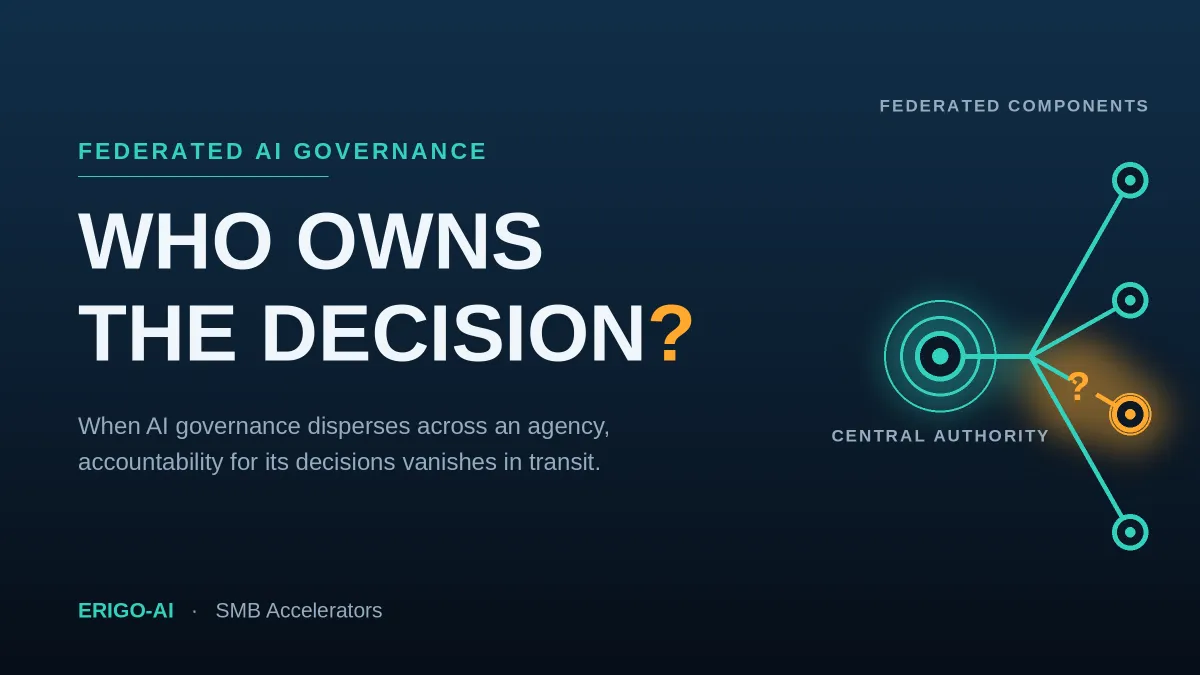
When Federal AI Governance Goes Federated, Who Owns the Decision?
The move from centralized to federated AI governance is the right answer to scale. It also opens an accountability gap that most transition plans never name.
Federal agencies are finally starting to take AI governance seriously and asking industry how to do it effectively. Most are answering the same way: by shifting governance authority from a small central team to their components and program offices. Federal AI policy, including OMB's M-25-21 guidance, points in the same direction, and the sheer growth in AI use cases makes centralized review unsustainable. Federated governance is the right structural answer to that pressure.
It also carries a cost that most transition plans I read leave out. When you disperse the authority to govern AI, you disperse the accountability for the decisions AI influences along with it. The chain of accountability gets harder to trace right when it matters most.
What gets missed is where the accountability checkpoint sits. Most frameworks, including the good ones, put it at the point of AI output generation: a person reviews the AI-generated assessment before it drives a consequential decision. That control is necessary, but it does not cover the real exposure. In a federated structure, the reviewed output does not stay put - it travels. It moves from the center, where it was produced and reviewed, to a component office that uses it to make a downstream decision, often months later and under conditions that have shifted since the review.
Picture how that fails. A central team produces a risk assessment with AI assistance and reviews it properly before release. A component office later uses that assessment to justify a resourcing or eligibility decision. Conditions have changed. The decision turns out badly, or just gets questioned. Now try to trace the accountability. The center says it only produced and reviewed the assessment, and the component made the call. The component says it relied in good faith on a reviewed assessment from the office responsible for governance. Both are right, and no one owns the decision. In a centralized model, one office held that line. Federation done carelessly lets accountability evaporate in transit.
None of this is an argument against federated governance. It is the right move. It is an argument for designing the accountability structure with the same care you give the org chart.
Here are two things that close the gap:
Assign accountability at every tier, not just at the point where the AI output is generated. Each tier that uses an AI-influenced output owns its use of it. The component that acts on an assessment owns the decision it makes from it, and that ownership gets named up front, before anyone has to reconstruct it after an incident. Obvious on paper. Almost never written into the transition plans I see, which define roles and decision rights for governance activity and leave the accountability for AI-influenced operational decisions implied.
Then build a real escalation path to a central adjudication function. Not to claw governance back to the center, which would defeat the point, but so that the hard cases, the ambiguous and novel ones that do not fit the established categories, get one consistent answer instead of stalling locally or getting decided a dozen ways across a dozen components. Document each resolution and feed it back as precedent. The framework should learn from its own hard cases, not keep relitigating them.
Sequencing is the whole game. Both of these are far cheaper to design in than to bolt on once components are already operating. Retrofit accountability onto a structure that has already dispersed, and you are running a political project rather than making a design choice. The window is before the transition, well ahead of the first contested decision.
Federated governance is how large agencies will manage AI at scale. The structure is sound. The accountability gap inside it is real and fixable, but only by design and only if the work happens up front. The agencies that name accountability at every tier and establish a learning escalation path are the ones that will still have an answer when an AI-influenced decision is challenged: who owned this and on what basis.
That question, who owned the decision and on what basis, is the one I keep coming back to in this work. It is the core of the governance framework I have been building, ERIGO-AI, and it is the piece I find most undercooked in how agencies are approaching the move to federated governance. If you are working on that transition inside an agency, or supporting one that is, I would be glad to compare notes.
Brian Morgan is the founder of SMB Accelerators and has spent more than 25 years in federal health IT across the VA, DoD, and HHS ecosystem.