Why Runtime Governance Is the Missing Layer in Federal AI Deployment
Federal AI governance has a structural gap: frameworks define what should happen, but nothing enforces what actually happens when AI systems are running in production. The policy infrastructure is real — NIST AI RMF, executive orders, over 40 states with AI-related legislation — but none of it operates at runtime. Between the documentation layer and the production layer, there is no enforcement mechanism translating governance intent into system behavior.
This is the runtime governance gap, and it's the most consequential blind spot in federal AI deployment today.
What does the federal AI governance stack actually look like?
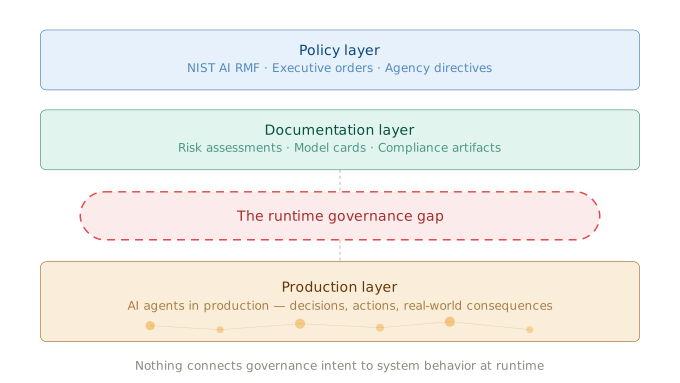
In most federal AI deployments, governance exists at three levels. At the top: policy — executive orders, agency directives, compliance frameworks. In the middle: documentation — risk assessments, model cards, impact analyses, and the artifacts that satisfy review boards. At the bottom: AI systems in production — agents making decisions, accessing data, calling tools, and taking autonomous actions.
The problem is how the documentation layer connects to the production layer. In most organizations, the answer is nothing.
Policy says what should happen. Documentation records what was planned. But nothing controls what the system actually does while it's live. The NIST AI Risk Management Framework is voluntary — it provides guidance across four functions (Govern, Map, Measure, Manage) but doesn't prescribe how those functions operate at execution time. Adoption remains thin even in high-stakes sectors — Brookings reported in March 2026 that under a third of mid-size U.S. hospital systems have formally implemented any AI governance framework.
Why does the runtime governance gap matter now?
Three forces are converging, making this gap urgent.
Agentic AI is entering federal production environments. According to Deloitte's latest State of AI in the Enterprise report, close to 75% of businesses plan to deploy AI agents by the end of 2026. In federal contexts — where AI is already used in healthcare diagnostics, energy grid load forecasting, and defense analytics — agents are moving from pilot to operational status. These aren't chatbots. They're systems that take autonomous actions with real-world consequences.
Voluntary frameworks are acquiring legal force. The NIST AI RMF may be voluntary, but it's increasingly referenced in state legislation, federal procurement requirements, and court proceedings. The Colorado AI Act explicitly cites it for safe harbor protection. Federal contractors are asked to demonstrate AI RMF alignment in proposals. Jones Walker LLP's February 2026 analysis traced the pattern clearly: what starts as voluntary guidance becomes absorbed into procurement requirements, then into regulatory expectations, and finally into litigation exposure. Failure to adopt recognized governance standards is already being used as evidence of negligence in litigation.
The regulatory landscape is fragmented and accelerating. As of April 2026, there is no comprehensive federal AI law. What exists is a patchwork of state regulations, agency enforcement actions under existing statutes, and federal-state tension over preemption. The December 2025 Executive Order signaled the administration's intent to centralize AI policy and challenge conflicting state laws, but its practical effect is uncertainty—not clarity. Organizations operating across jurisdictions face materially different definitions of what constitutes a "high-risk" AI system.
What is NIST doing about agentic AI governance?
NIST has acknowledged the gap directly. In February 2026, NIST's Center for AI Standards and Innovation (CAISI) launched the AI Agent Standards Initiative — the first U.S. government program dedicated to interoperability and security standards for autonomous AI systems. The initiative is organized around three pillars: industry-led standards development, open-source protocol development (co-invested with NSF), and fundamental research in AI agent security and identity infrastructure.
Separately, NIST's NCCoE published a concept paper on AI Agent Identity and Authorization exploring how existing identity standards apply to software agents operating in enterprise environments. The direction is clear: agents should operate under constrained permissions scoped to specific tasks, with explicit approval gates for high-impact actions. As CSA's Agentic AI profile for NIST AI RMF concluded, agentic systems need monitoring that covers not just uptime but operational behavior, security posture, compliance state, and the human oversight layer — a far broader scope than traditional software monitoring.
What does runtime governance actually require?
Runtime governance is not monitoring dashboards or periodic reviews. It's a set of architectural capabilities that operate continuously while AI systems are in production.
Policy enforcement at execution time. Governance rules are applied at runtime, not just at configuration time. Agents operate within defined policy boundaries — enforced continuously, not audited after the fact.
Agent identity and access scoping. Each agent operates under a defined identity with explicit permission boundaries. Access to systems, data, and downstream agents is scoped and logged at every step.
Behavioral monitoring against baselines. Real-time observation of agent actions against expected behavioral baselines. Anomalies flagged. Out-of-policy execution intercepted before downstream impact.
Continuous, tamper-evident audit generation. Every agent action, decision, and policy event is logged with full provenance — not periodic reports, but continuous evidence generation designed to support compliance review, inspection, and ATO processes.
What should federal AI programs do about this?
Most federal programs have invested heavily in the policy and documentation layers. Those investments are necessary but insufficient without a runtime layer that translates governance intent into system behavior.
The question isn't whether your organization has an AI governance framework. It's whether that framework has any authority over what your AI systems actually do in production. If the answer is no — if there's air between your policies and your production systems — you have a governance gap that additional documentation won't close. The gap is architectural, and it requires an architectural solution.
This is what we're building at SMB Accelerators. ERIGO-OS™ is a runtime governance engine designed from the ground up for federal and enterprise AI deployments — policy-driven enforcement, continuous behavioral monitoring, identity and access scoping, and tamper-evident audit trails. Built for the compliance, evidence, and control requirements that federal environments demand — not adapted from a commercial product after the fact.
ERIGO-AI™ provides the governance framework that feeds ERIGO-OS — treating AI governance as a system design problem rather than a policy problem. The assessment produces a signed governance profile that directly seeds runtime configuration.
If your organization is deploying AI agents without runtime governance, that's a conversation worth having.
Sources
National Institute of Standards and Technology. "AI Risk Management Framework FAQs." NIST.gov. nist.gov/itl/ai-risk-management-framework
National Institute of Standards and Technology. "Announcing the AI Agent Standards Initiative for Interoperable and Secure Innovation." February 18, 2026. nist.gov/news-events
NIST NCCoE. "Accelerating the Adoption of Software and AI Agent Identity and Authorization — Concept Paper." February 5, 2026. csrc.nist.gov
Cloud Security Alliance. "NIST AI Risk Management Framework: Agentic Profile." April 2026. labs.cloudsecurityalliance.org
Jones Walker LLP. "NIST's AI Agent Standards Initiative: Why Autonomous AI Just Became Washington's Problem." February 26, 2026. joneswalker.com
Altitudes Magazine. "Federal AI Regulation Remains 'Undefined' as Critical Infrastructure Gaps Widen." April 2, 2026. altitudesmagazine.com
Morgan Lewis. "AI Enforcement Accelerates as Federal Policy Stalls and States Step In." April 2, 2026. morganlewis.com
Sidley Austin LLP. "Unpacking the December 11, 2025 Executive Order: Ensuring a National Policy Framework for AI." December 23, 2025. sidley.com
Glacis. "NIST AI RMF Implementation Guide 2026." December 20, 2025. glacis.io
Raconteur. "Autonomous AI Agents 2026: The New Rules for Business Governance." March 2026. raconteur.net
Brian Morgan is the Founder & CEO of SMB Accelerators, Inc. and the architect of the ERIGO platform — an integrated governance, assessment, and runtime enforcement system for AI in federal and enterprise environments. He brings 25+ years of federal IT leadership, including serving as an IT Director at the VA ($100M+ budget, ~300 staff) and in senior positions at ManTech, Perspecta, Peraton, Agile Six, and GovCIO. He is a published AMIA author, 2011 EHR Game Changer Award recipient, and holds FEAC CEA and FAC P/PM Senior credentials.